
Blog
The USD24tn+ Climate Investment Opportunity
Published: 05 Nov 2026
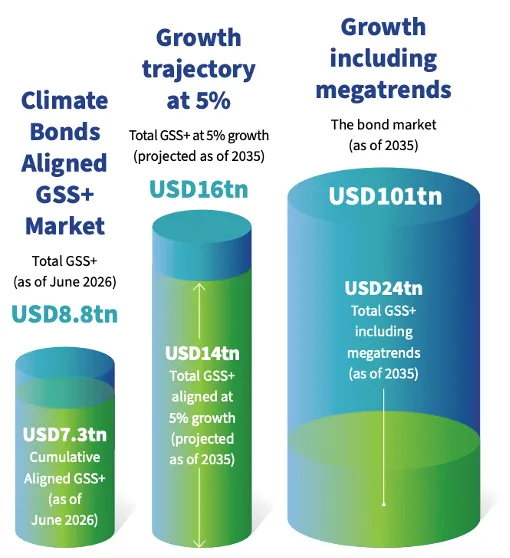
It took the sustainable debt market 13 years to reach its first USD1tn — now, it’s adding almost USD1tn every year. In the first half of 2026, cumulative green, social, sustainability, and sustainability-linked (GSS+) issuance aligned with Climate Bonds methodology passed USD7tn.
The next wave of investment opportunities is already taking shape, and more than USD24tn in sustainable debt investment opportunities could emerge over the next decade. From clean energy and electricity grids to industrial transition and resilient infrastructure, credible and ambitious projects are offering investors a substantial pipeline to finance a more sustainable economy.
Climate Bonds’ new report, The USD24tn+ Climate Investment Opportunity, assesses this pipeline over 2026–2035. It combines USD16tn from the expected organic growth of the green, social, sustainability, and sustainability-linked (GSS+) bond market, assuming a prudent 5% annual growth rate, with an estimated USD8tn in debt supply from five global megatrends. Depending on market growth, the reality is this number could be far beyond that.
The scale of the opportunity is clear. For investors, this represents a significant opportunity to finance and guide the infrastructure, industries, and technologies shaping the next decade. How much of this investment becomes green and investable will depend largely on government policy, supported by credible, science-based standards.
A growing market, a substantial pipeline
The GSS+ market has grown rapidly over the past decade. The cumulative volume of aligned GSS+ bonds issued increased from USD2.8tn in 2021 to USD7.3tn as of 30 June 2026. Aligned issuance has averaged approximately USD1tn a year since 2021, demonstrating the market’s capacity to mobilise capital at scale.
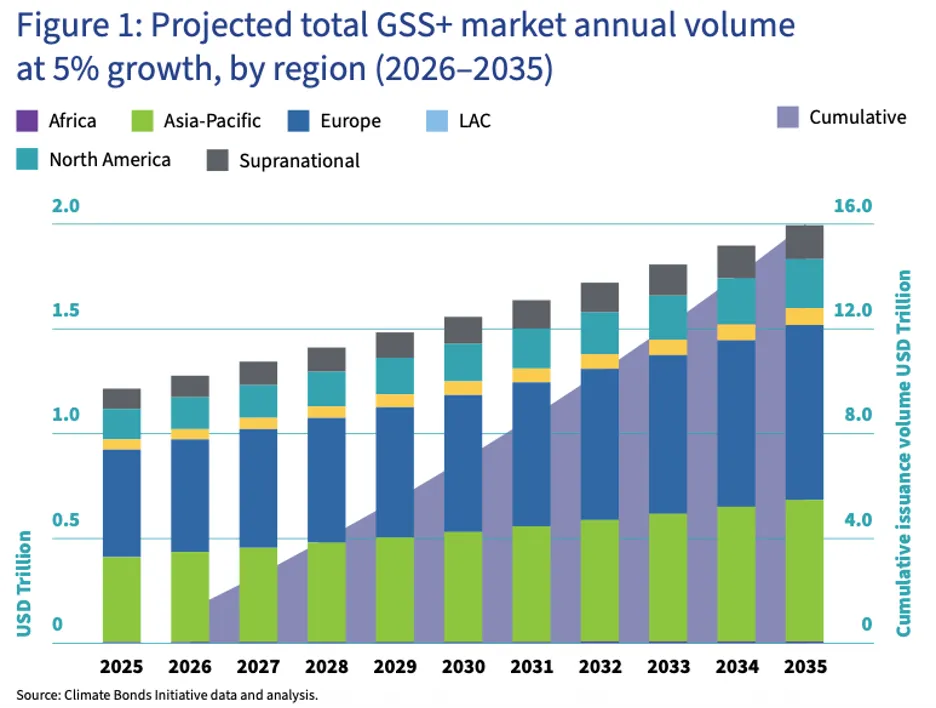
A prudent 5% annual growth rate for the wider GSS+ bond market points to a USD16tn investment pipeline over 2026–2035. This is a conservative assumption: average annual growth between 2021 and 2025 stood at 8.6% for aligned GSS+ volume and 10.4% for the wider GSS+ market.
The USD16tn base figure reflects only the expected organic growth of the GSS+ bond market. As key megatrends are brought into scope, the market is likely to grow well beyond this. Green loans, along with public and private equity and debt markets, offer further room for expansion.
Five megatrends driving the next wave
Global transformations in energy supply, computing power demand, and industry could deliver a huge green investment pipeline.
The report identifies five megatrends: electrification and grids, industrial transition, artificial intelligence, critical minerals, and adaptation and resilience. Together, these require an estimated USD28.7tn of investment over the next decade, offering significant upside beyond current forecasts.
Based on industry average debt-to-equity ratios, Climate Bonds estimates that approximately USD8tn of this investment requirement could be financed through debt. This includes loans and bonds, reflecting the potential investment supply available to banks and bond investors.
Energy, buildings, and transport account for 70% of aligned use of proceeds to date, and all three have ambitious plans to expand. By 2035, electric vehicles are expected to significantly surpass 50% of global sales. By 2030, net-zero carbon buildings are predicted to occupy 50% of new commercial development.
While these sectors may remain the core supply of issuance volume, grids, AI data centres, clean industry, and resilience will emerge as major new sources of issuance, together significantly adding to the investment pipeline.
Policy turns opportunity into investment
How much of this investment becomes green, investable pipeline is being determined largely by government policy.
Robust real-economy policy across Asia and Europe in particular is driving significant proportions of new infrastructure and power installations to be aligned with green definitions and sustainable investor appetite. The report highlights 15 countries, across emerging and developed markets, that show how constructive policy turns these trends into investable pipelines.
These transformations also carry risks. Without alignment with climate goals, they could result in fossil fuel expansion, increased emissions, and environmental degradation. Robust policy can harness them to deliver green and resilient economic growth.
Cohesive and transformational policy, together with scientifically based standards and assessments, can support a credible investment landscape for issuers and investors.
Building the next decade of sustainable growth
The demand for issuance has been proven. Issuers and investors alike need on-going and increased clarity as to what can be identified as credible, science-based investment.
The potential USD24tn sustainable debt pipeline will not become a reality through demand alone. It needs clear policy, credible standards, and transparency about where the money goes. The market has demonstrated its capacity to grow. Now policymakers, issuers, and investors must ensure that growth delivers on its promise.
Read The USD24tn+ Climate Investment Opportunity to explore the sectors, policies, and market trends shaping the next decade of sustainable investment.

Spotlight: Climate Bonds Taxonomy
Related Blogs